Overview
The thraex is not an ethnic but a weapon-class designation: it denotes an arena fighter armed "in the Thracian manner". The type spread through the Roman arenas during the 1st century BC, from the time of Sulla — in the context of the Mithridatic Wars and the Roman army's encounters with Thracian enemies. By the imperial era it was among the most common and popular gladiator types. Horace (Epist. 1.18.36) already mentions the phrase Thraex erit, alluding to the arena fate of the poor man.
Historical accuracy and our shows
The thraex is the classic "light" type of the post-Augustan 1st–2nd century AD arena world — the natural opponent of the murmillo and the hoplomachus. Its appearance can be documented after the conquest of Thrace (168 BC); it becomes standardised in the Augustan age and endures throughout the entire imperial period. Our shows evoke this broad 1st–2nd century period: the sica (a curved-bladed sword), a small square parmula, a tall helmet decorated with a griffin or eagle, a pair of tall ocreae (on both legs), and a manica on the sword arm.
Differences between periods:
- Republican era (2nd–1st c. BC): less standardised equipment, at times closer to genuine Thracian military arms. This does not fit our shows.
- Augustan age: the sica + parmula + tall ocrea combination becomes uniform.
- 1st century AD (Julio-Claudian and Flavian era): the classic Pompeian form. The Pompeian (AD 79) bronze examples are our reference.
- 2nd century AD (Antonine age): the curve of the sica becomes more pronounced in some depictions, and helmet decoration grows still richer. The Bad Kreuznach (3rd century) and the Zliten mosaic (c. AD 200) are contemporary or near-contemporary visual sources.
Images
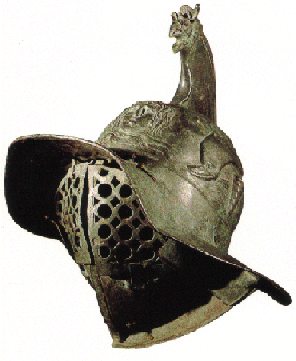
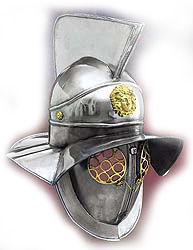
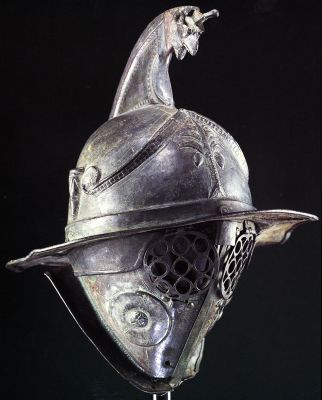
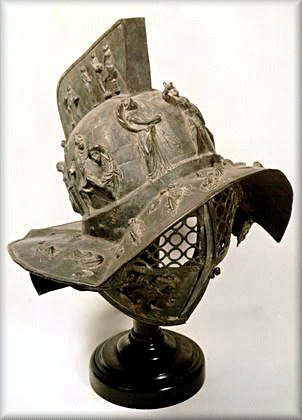
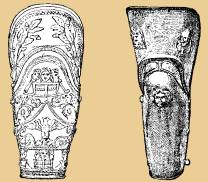
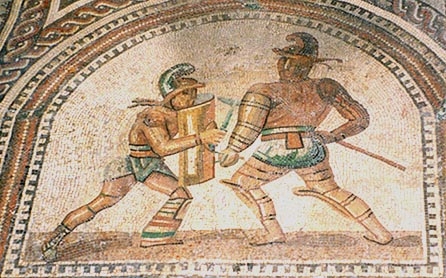
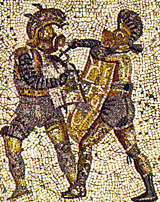
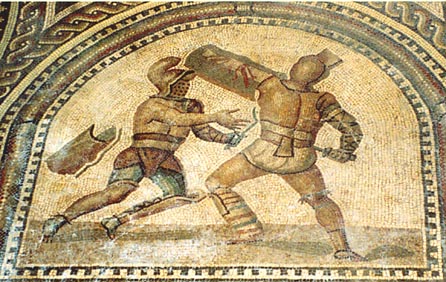
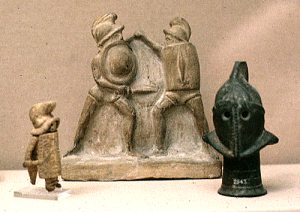
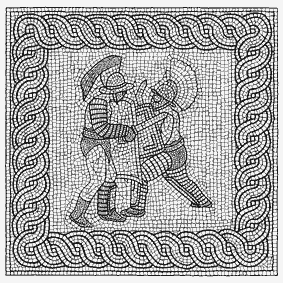
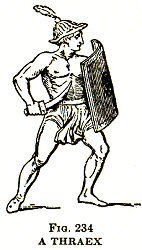


The images hosted on gladiator.hu were collected by the association; the images linked from Wikimedia Commons are photographs of ancient archaeological monuments in the public domain or under free licences. The British Museum and Pompeii objects can also be viewed directly on the institutional pages (see Sources).
Weapons and equipment
- Sica — a short sword with an inward-curving blade, a miniature relative of the Dacian falx. The curved blade could reach the opponent's more exposed points (shoulder, back, thigh) even behind a large shield. Blade length c. 30–45 cm.
- Parmula — a small shield of c. 60 × 65 cm (it could be square, rectangular or round).
- Helmet — a broad brim, a full-face visor, a tall crest, often decorated with a griffin head or wings (the griffin is the companion animal of Nemesis, the goddess of the arena). The helmet from the Caserma dei Gladiatori at Pompeii is in Naples (inv. 5649).
- Two tall greaves (ocreae) — reaching even up to the upper thigh left exposed by the small shield. One of the main identifying features.
- Manica on the right arm.
- Subligaculum, balteus, and thickly wound cloth padding on the thigh.
Typical opponent
The thraex belonged to the parmularii (the small-shield fighters); his typical pairing was the large-shielded Murmillo of Gallic origin. Less frequently the Hoplomachus (a fighter modelled on the Greek hoplite) could also be his opponent. The Zliten mosaic (c. 2nd century) depicts several such pairings.
Caligula and the thraeces
Caligula was an open patron of the thraeces. Suetonius (Caligula 55.2) reports on this explicitly: he made certain thraex gladiators commanders of the German bodyguard, and cut down the equipment of the murmillones, because they were the rivals of his favourites. The same emperor (Caligula 26) sent Aesius Proculus into the arena out of cruel caprice, first against a thraex and then against a hoplomachus.
Further ancient literary mentions
- Horace, Epistulae 1.18.36 — Thraex erit.
- Cicero, Pro Sestio 134 and Philippicae — the small-shield / large-shield opposition as a political metaphor.
- Petronius, Satyricon 45.12 — the thraex as a recognisable weapon class.
- Juvenal, Sat. 8.199–210 — a senatorial scion as a gladiator.
- Martial, Liber Spectaculorum 29 — the parmularius Hermes as a "threefold" gladiator.
- Artemidorus, Oneirocritica 2.32 — the symbolism of a dream-fight against a thraex.
Archaeological and visual sources
- Pompeian frescoes and helmet finds — the fresco uncovered in Regio V in 2019 depicts a murmillo–thraex duel. The griffin-crested helmet from the Caserma dei Gladiatori (VIII.7.16) is the "canonical" depiction of the type.
- Gladiator relief from Halicarnassus (British Museum, inv. 1847,0424.19) — a 2nd-century "Amazon and Achillia" relief, with female fighters in thraex or parmularius equipment.
- Zliten mosaic (Tripoli, Archaeological Museum) — explicit Thraeces vs. murmillones pairings.
- Thyatira gravestone (TAM V,2 1043, c. 200–300) — an Asia Minor thraex stele.
Disputed elements
- The question of ethnic origin: the thraex is armed in the Thracian manner, but from the 1st century AD it no longer indicates actual Thracian descent.
- The exact curve and length of the sica are disputed — they can be reconstructed from finds and depictions.
- The shape of the parmula varied by period and by province.
- The visual distinction between the thraex and the hoplomachus is difficult on some provincial depictions.
Sources
- Suetonius, Caligula 55 — Penelope: penelope.uchicago.edu
- Britannica, "Gladiator": britannica.com
- Encyclopaedia Romana, "Thraex": penelope.uchicago.edu
- British Museum, Halicarnassus gladiator relief (1847,0424.19): britishmuseum.org
- Pompeii Sites, "Fresco of the Fighting Gladiators – Regio V" (2019): pompeiisites.org
- Parco archeologico del Colosseo: colosseo.it
- Junkelmann, Marcus: Gladiatoren. Das Spiel mit dem Tod. Mainz: Philipp von Zabern, 2008.
- Carter, Michael J.: "Gladiatorial Combat: The Rules of Engagement", Classical Journal 102.2 (2006), 97–114.
- Thyatira thraex gravestone — Livius.org: livius.org