Overview
The dimachaerus (Greek διμάχαιρος, "two-sword" or "two-knife" fighter) is a rare and distinctly poorly documented type of the Roman arena. Only scattered, late and indirect evidence attests to its existence; its appearance in earlier periods (the Republic, the early Imperial era) cannot be verified. On the basis of the sources, the type can be placed mainly in the 2nd–3rd century AD, and rather in the Greek eastern provinces.
Historical accuracy and our shows
The dimachaerus was active in the 2nd–3rd century AD. The type fits the second half (the Antonine period) of the post-Augustan 1st–2nd century AD timeframe of our shows; featuring it in our 1st-century Julio–Claudian or Flavian scenes is not historically justified, because the type is not documented before then. The sources pointing to its existence all date from the 2nd–3rd centuries: Artemidorus (Oneirocritica 2.32), the Commodus biography of the Historia Augusta, and inscriptions from Halicarnassus and Asia Minor.
In our shows the dimachaerus may appear in the 2nd-century scenes — especially as a rare speciality of the Greek East, evoking the tradition of the gladiator schools of Asia Minor (Halicarnassus, Pergamon).
An important caveat: the details of the equipment are largely based on reconstruction — direct material finds (blade type, armour, helmet) are almost nonexistent. In our shows we explicitly indicate that the equipment (two blades, no shield, presumed scale or mail armour, manica, high ocrea, closed helmet) is a cautious scholarly reconstruction — following Junkelmann. We avoid the film and video-game image of the "two-sword-whirling, unarmoured acrobat".
Images
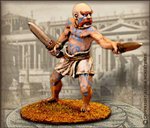
No unambiguous ancient visual source is known for the type; the image above is a reconstruction. The identification of the scattered epigraphic evidence from Halicarnassus and elsewhere in Asia Minor is disputed.
Weapons (disputed)
- Two short, straight or slightly curved blades.
- The Greek word machaira originally denoted a cutting knife or short sword — it is unclear whether a straight, gladius-like blade or a curved, sica-like blade is meant.
- Both Junkelmann and Meijer note that the exact blade type cannot be verified archaeologically.
Protective equipment (reconstruction)
- In the absence of a shield, modern scholarship assumes heavier body armour: mail or scale armour (lorica hamata or squamata).
- A manica on the arm, a high ocrea (greave) on the leg, a closed helmet.
- He certainly carried no shield, since both hands were occupied by his weapons.
- Important: this is predominantly logical reconstruction, not based on material finds.
Typical opponent (uncertain)
The sources do not name one. The modern assumption is that he faced either another dimachaerus or a more lightly armoured type (e.g. a retiarius, possibly a thraex) — but this is speculation.
The ancient sources (very few)
Only three or four passages refer directly to the type's existence:
- Artemidorus, Oneirocritica 2.32 — mentions the dimachairos among the gladiator types in a dream-interpretation context.
- Historia Augusta, Vita Commodi (the biography attributed to Lampridius) — it comes up in connection with Commodus's appearances. The reliability of the Historia Augusta is disputed in general, so this is not strong evidence.
- A funerary inscription and relief from Halicarnassus — the designation dimachairos appears on a gladiator memorial stone from Asia Minor. This is the most important epigraphic trace, but it is a single mention.
- Other scattered inscriptions from the Greek-speaking areas of Asia Minor (Robert's 1940 collection).
Archaeological and visual sources
- Not a single certain visual depiction can be unambiguously linked to the type.
- A possible scene among the Halicarnassus reliefs is often cited, but the identification is disputed.
- Archaeologically, the type is almost invisible.
What is certain and what is not
- Certain: the designation dimachaerus / dimachairos occurs in ancient sources.
- Probable: it was a genuinely existing but rare gladiator type, mainly in the Greek East.
- Speculative: the full reconstruction of the equipment (armour, helmet, blade type, opponent). Modern depictions (drawings, reenactment equipment, documentaries) are largely based on logical inference, not on finds.
Sources
- Junkelmann, Marcus: Das Spiel mit dem Tod. Mainz: Philipp von Zabern, 2000. — Cautious treatment, emphasising the uncertainty.
- Meijer, Fik: The Gladiators. Thomas Dunne Books, 2005.
- Artemidorus: Oneirocritica 2.32. English translation: Robert J. White (Park Ridge, 1975); Daniel E. Harris-McCoy (Oxford UP, 2012).
- Historia Augusta, Vita Commodi — Loeb / Penelope: penelope.uchicago.edu
- Britannica, "gladiator": britannica.com
- Robert, Louis: Les gladiateurs dans l'Orient grec. Paris, 1940.
- Carter, Michael J.: "Gladiatorial Combat: The Rules of Engagement", Classical Journal 102.2 (2006/2007), 97–114.
- Köhne, E. – Ewigleben, C. (eds.): Gladiators and Caesars. London: British Museum Press, 2000.